What Alabama’s National Championship taught me.

Perhaps you occasioned to watch the University of Alabama’s football team defeat the University of Notre Dame’s football team last Monday night to win the college football national championship for the second year in a row and for the third time in the last four years.  It was not much of a game as Alabama had things in hand by the end of the first quarter and by the first drive of the second half it was all over.  The dynastic dominance of Alabama and their head coach, Nick Saban, was firmly established.

As a Catholic priest I am obliged to root for Notre Dame and as a son of the mid-west and chaplain at a Big Ten school I am bound to have a healthy animus against the football-crazed south.  Therefore I was all exited to disdain Alabama and let my angst at their victory show itself by detracting from what certainly must be a lame university and a vice-ridden and over-zealous football culture.  But then I did a little investigation and was quite turned around.

Regardless of what one thinks about major college football – there is a gaudy amount of money and a clear over-importance placed on this game – there is a lesson to be learned about what makes for a successful and virtuous person and team.

First is the coach, Nick Saban.  Mr. Saban is a practicing Catholic (which certainly endears him to me) and, by all accounts, a virtuous man.  He is good to his family and straight with his players.  He has a reputation for tireless work and a solid routine.  Further, while he is very demanding of his assistant coaches he treats them fairly – assigning a clear task with clear expectation.  He is no harder on his players than he is on himself and his players seem to all report a great respect for him.

Second is a clean football program.  The University of Alabama football team has been the least penalized team in college football the last five years running.  The team has a graduation rate of 77%, which is higher than the student body of most major American universities.  Lastly, the football program has not had even a whiff of NCAA violations.

Third is that it’s not all born talent.  Alabama, under Nick Saban, had never had the number one recruiting class in the country.  Certainly talented players come to Alabama but they also grow a lot in their skill.  Running back Eddie Lacy, a superstar last season and a Heisman trophy candidate for next year, was the 13th highest rated running back coming out of high school and the 116th rated recruit overall.  At Alabama they seem to know how to work, how to sacrifice and how to get better, how to become the best.

Last, they succeed.  Only the jealous could argue.  My point is this: don’t hate success, try to emulate it.

Of course there are plenty of instances where the successful have cheated, worked the system, brutalize others to succeed, prevented others for succeeding.  All the more reason to highlight success when it is done the right way.

Set clear goals.  Learn from others who achieved those goals.  Hold yourself and others accountable.  Avoid mistakes and pitfalls.  Keep bad influences away.  Work hard.  Sacrifice  for your goal.  Get the most out of what you have.  You will succeed.

These are all Christian ideas and translate so easily to the spiritual life

I am not canonizing Alabama football or Nick Saban.  Nor am I saying that football is life or even should be.  What I am saying is that it is very encouraging to see success, the achievement of goals, done in the right way.  Who knows if it will continue, but for the moment I will learn a lesson – don’t hate the Saints, don’t put them on unreachable pedestals, don’t watch them like characters in a movie –  BE LIKE THEM.

Long roads

It was famously written of priests that they are, ‘a member of every family yet belong to none.’  What true and honorable words.  There is a great dignity, privilege, grace in being a priest of Jesus Christ.  But also a deep sorrow, a grief that comes with being so aware of the passing nature of this vale of tears.

No place is home.  

Now, don’t get me wrong, my parents house is always open to me and I love it there.  Many friends will welcome me in for food and shelter and hospitality.  Heck, the rectory I live in is warm and dry and I’ve even got my own bathroom.

But none of them are mine – my parents house is theirs, same too my friends, and while the rectory is nice I am merely a long-term guest in a house belonging to no one.  Not to mention the eschatological reality, ‘not one stone will be left upon another.’

Thus it is right and just.  Priests ought not become too bound to one place.  They must be wandering pilgrims of a sort.  After all, ‘the Son of Man has no place to lie His head.’  Ours is a comfortable wandering (at least in America) but it is still a wandering.  So there is a tension.   Human beings strive for community, for belonging, and a priest can never truly belong.  He is always one foot in Heaven and one on earth.  Loves every person but cannot be long, cannot posses any one.  This is a fact of his nature and to transgress it would be to offend who he is.  Thus he remains odd,  not quite like all the others. 

This is not an excuse for weirdness: being rude, inappropriate, negligent,

Continue reading

Homily – 2 Sept. – Welcome to St. Paul’s

The academic year is nearly upon us once again – classes at the University of Wisconsin Madison start on Tuesday.

Click on this title – XXII Sunday per Annum – to hear my homily from this Sunday – September 2nd.

Welcome to all new Badgers and to all those who walk through our doors at St. Paul’s and wish to journey towards eternity with us.

I am a priest for you, I love you and welcome any way to serve you.

Rome Experience – Some Thoughts from Day 4

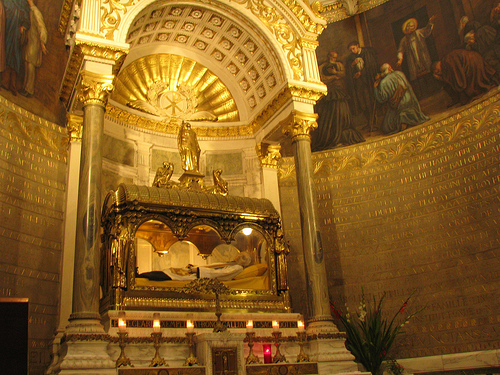
The sun always rises in the East and that is especially nice after a hot evening.  Don’t misunderstand, I am a Catholic priest in the little city of Ars, France – likely one of the holiest places on earth.  It has a feel like Assisi.  Less medieval to be sure but still nice, quaint, simple and centered around a holy man.  There is a peace that only holiness and simplicity can bring.  Still southern France is like southern almost everywhere else – hot, humid and has bugs.  So I slept well, if a bit uncomfortably and rose to a cool morning.

When you rise with the Presence of Jesus Christ not ten feet away it adds a whole new dimension to your reality.  So the bright morning shines a little brighter and though the back might ache from sleeping funny (and being twenty pounds overweight) there is a quick spring in the step.  Off to prayer and then the Mass.  It was simple, no sermon, plainchant in the modo simplex.  The sound of all male voices takes a priest back to the seminary, and in a good way.  Time intersects with eternity and then one is off to breakfast.

After, there is a walk into town.  Three priests, so different, so varied in personality and perspective yet all the same, exactly the same – one God, one Faith, one Baptism, one Priesthood.  There is a cup of coffee and pleasant conversation.  The you go to visit God on earth in the Sacrament and pay respects to the mortal remains of a giant, a hero, a man you hope to be.   The feeling is small – I am the lesser son of greater fathers.  And it is also big – God gives me the same grace as my fathers and I can, I must be a greater saint than they.

Time moves on, the sun grows higher and the skies get warmer and warmer.  A simple rosary in a black robe, praying with so many little brothers who hope to walk one day the path you trod.  They do not admire, that if for legends and we are very much flesh and blood, they respect, they listen.  Praying, singing to the good God, talking the spiritual things all through the afternoon and then back to the silence of heart and prayer do these souls go.

What an odd life we lead.  One foot in time another in eternity.  We go back and forth, forth and back.  It can be all so dizzying some times and one might feel privileged or un-worthy or ungrateful.  I suppose one should feel all of these things.  Such an odd life.  Yet it is also sacrifice, gift, offering.  A young man learned his grandmother passed away today.  He shed a loving tear, he prayed and talked and shared.  He will not see her buried, he will not have that visible consolation.  Why?  Because he is offering himself – in time and for eternity.

Perhaps we are all God’s mad-men, chasing after old dreams and dead heroes.  Perhaps not.  Perhaps we are the light of the world and the salt of the earth, treading this beautiful and tired land and finding new Faith and living Spirit.

Tonight is cool.  There is lightening in the clouds off in the distance, a storm is coming.  Time presses ever forward as we are silent and praying and preparing to preach and reach eternity.  We call out with the great Saint of Ars, “Courage my soul!  Time presses onward and eternity draws nearer.  May we live this hour as we hope to die!”

I should go to bed and you, perhaps, should pray.  Night falls on Ars but eternity dawns everywhere – for we will say the Mass tomorrow, perhaps you will say it yet today.  And I am glad to be here, with these good men.  Hope is very much alive – for our time and for eternity.

Agere sequitur esse (Prologue to a commentary on Hipsterism)

Some may know that the above is one of my most oft repeated maxims – AGERE SEQUITUR ESSE – translated, ‘action follows being.’

This simple phrases constitutes the fundamental metaphysic of the human person as the Church sees the human person and, I would contend, the only maxim that metaphysically prevents using people as things and thus opening up a whole universe of abuses that can be perpetrated against human beings as well as create a cultural silliness wherein people are perfectly happy to tolerate these abuses.

The world of philosophy rested on this principle for over of two millenia until Descartes gave us a more familiar maxim – COGITO ERO SUM – translated, ‘I think, therefore I am.’  This flipped the world of philosophy on its head.  Rather than being having primacy in the defining conceptualization of the human person action, doing, has the primacy.

While I would never question the purity of Descartes intentions.  The man himself lived the life of a practicing Catholic and claimed faith until the day he died. He was also the personal tutor to Queen Christina of Sweden, who famously abdicated her throne to convert to Catholicism.  However, none can doubt that his philosophical principle has had disastrous effect.  As Descartes’ contemporary Blaise Paschal said, “I cannot forgive Descartes; in all his philosophy, Descartes did his best to dispense with God. But Descartes could not avoid prodding God to set the world in motion with a snap of his lordly fingers; after that, he had no more use for God.”  Pensees 

Much of contempory cultural thought was born and continues to live and move in the upside-down world of cogito ergo sum and its inherently materialist and egoistic structure.  We must reject this.  As Blessed John Paul II said in his book Memory and Identity,

We have to go back to the period before the Enlightenment, especially to the revolution brought about by the philosophical thought of Descartes. The cogito, ergo sum (I think, therefore I am) radically changed the way of doing philosophy. In the pre-Cartesian period, philosophy, that is to say the cogito, or rather the cognosco, was subordinate to esse, which was considered prior. To Descartes, however, the esse seemed secondary, and he judged the cogito to be prior. This not only changed the direction of philosophizing, but it marked the decisive abandonment of what philosophy had been hitherto, particularly the philosophy of Saint Thomas Aquinas, and namely the philosophy of esse.

If people are fundamentally defined by their acts we will get a skewed notion of the human person.  A simple example.  We ask, “Who is Aaron Rodgers?’  Answer, “Aaron Rodgers is a football player.”  The answer is true enough, but at what level of truth?  Only a simplistic one, a materialistic one.  Perhaps it is better say the the above answer is factual more than it is true.  It does not even come close to approaching real questions about the human person but it satisfies because it remains effective on the simple level of material reality.

What about moral questions regarding the human person?  What about cultural questions?  Such questions are not principally, sometimes not at all, material questions.  They are inherently transcendent.  But the cogito, the materialist cannot answer questions about the transcendent, they have no categories for such questions.  All he can do is react, all he can do if feel.

This results in philosophical emotionalism – “the doctrine that all evaluative judgments and more specifically all moral judgments are nothing but expressions of preference, expressions of attitude or feeling, insofar as they are moral or evaluative in character.”  (Alistair McIntyre, After Virtue)

If emotionalism holds true it is death to the moral and cultural pillars of any civilization that would tolerate such a philosophy as a part of the accepted pubic discourse.  McIntyre said further in After Virtue, that if emotionalism were true,

Evaluative utterances can have, in the end, no point or use but the expression of my own feelings or attitudes and the transformation of the feelings and attitudes of others.  I can genuinely appeal to impersonal criteria, for there are no impersonal criteria.  I may think that I so appeal and other may think that I so appeal, but these thoughts will always be mistakes.  The sole reality of distinctively moral discourse is the attempt of one to align the attitudes, feelings, preferences and choices of another with its own.  Others are always means, never ends. 

Hopefully the danger of cogito ergo sum and its resultant emotionalism are becoming clearer.  Keep an eye this is public discourse.  Certainly there are many, many important things to do and doing is an inherently important part of human life.  But, are giving ‘being’ questions ‘doing’ answers?  If so, we have fallen into a trap and must step out.